


Financial reporting for French subsidiaries: how to provide reliable monthly reporting to your headquarters in Asia?
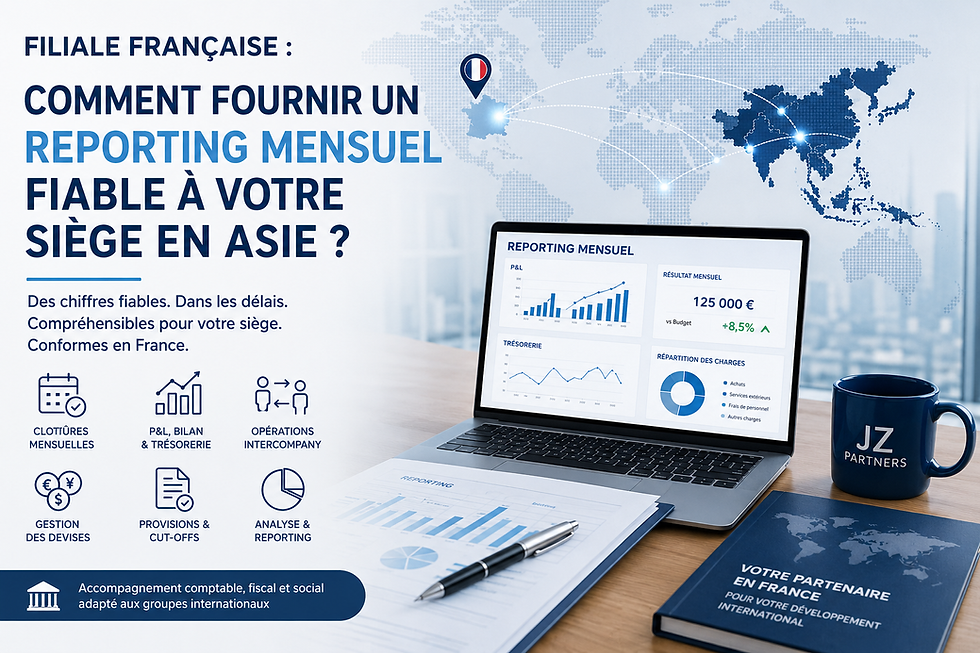
For a French subsidiary belonging to a Chinese, Japanese, Korean or more broadly Asian group , French accounting is not only used to comply with local tax obligations.
Each month, headquarters generally expects a financial report from the French subsidiary, transmitted quickly and in a format compatible with the group's standards.
Revenue, expenses, monthly profit, cash flow, accounts receivable, accounts payable, VAT, provisions, social security contributions, intercompany transactions… The information requested can be extensive.
And that's precisely where the difficulties begin.
A report may be perfectly understandable for a French accountant, while being difficult to use for a finance department located in Shanghai, Shenzhen, Hong Kong, Tokyo, Seoul or Singapore.
For a French subsidiary, the challenge is therefore twofold: to comply with French accounting and tax rules while producing financial information adapted to the requirements of the Asian headquarters.
1. Why is reporting for a French subsidiary often complex?
International groups generally seek to quickly consolidate the results of their various entities.
The headquarters can therefore request the following each month:
a general balance;
a monthly and YTD profit and loss statement;
an assessment;
a cash flow situation;
monitoring of customer and supplier accounts;
a breakdown of the charges;
budget monitoring;
intercompany operations;
tables of provisions and expenses to be paid;
tax and social security information;
Financial reporting for the French subsidiary according to the accounting plan or group standards.
The problem is that the timing, methods and presentation of French accounting do not necessarily correspond to the group's internal standards .
A simple accounting extract is therefore not always sufficient.
2. French accounting and group reporting: two different approaches
In France, the subsidiary must keep its accounts in accordance with French rules and comply with its tax, social and legal obligations.
The Asian headquarters often reasons differently.
His primary aim is to have an economic view of the subsidiary and to integrate its figures into the group's consolidated reporting.
It can notably use:
a group chart of accounts different from the French General Accounting Plan;
different rules for recognizing turnover;
categories of expenditure specific to the group;
another reporting currency;
IFRS standards or local accounting standards;
a much shorter closing schedule.
Therefore, a mapping needs to be put in place between French accounting and headquarters reporting .
For example, several French accounts may need to be grouped into a single category within the group. Conversely, a French accounting account may need to be broken down into several reporting lines.
Without structured mapping, manual reprocessing increases and the risk of error increases.
3. The main challenge: successfully completing the monthly closing
In some Asian groups, figures are requested very quickly after the end of the month: J+3, J+5 or J+7 for example.
To meet these deadlines, waiting for the French annual closing is obviously impossible.
The subsidiary must organize a proper monthly closing process .
This includes, in particular, quickly retrieving supplier invoices, recording customer invoices, reconciling bank statements, controlling accounts, recording expenses payable and revenues receivable, analyzing payroll elements and identifying intercompany transactions.
The objective is simple: to obtain a sufficiently complete and reliable financial picture each month to allow headquarters to make its decisions.
4. Beware of missing invoices
This is one of the main sources of discrepancy between monthly reporting and annual accounts.
Let's take an example.
A service costing €20,000 was provided in June, but the supplier's invoice only arrived in July.
If no unreceived invoices (FNP) are recorded at the end of June, the result for the month will be artificially higher by €20,000.
For the seat, this can distort:
the margin;
the operating result;
the budget/actual comparison;
the forecasts;
the consolidation of the group.
Reliable monthly reporting therefore requires a true accounting cut-off logic, even when some supporting documents are not yet available.
5. Intercompany transactions: a particularly sensitive issue
For a French subsidiary of an Asian group, intra-group transactions often represent a significant portion of the flows.
This could include:
management fees;
purchases of goods from the parent company;
IT services;
personnel re-invoicing;
marketing costs;
royalties;
intragroup loans;
current accounts;
various re-invoicing.
These transactions must be correctly identified and reconciled with the figures from headquarters.
A difference in date, currency or amount between two companies in the same group can create discrepancies during consolidation.
It is therefore recommended to perform regular intercompany reconciliations before sending the monthly report.
Beyond reporting, certain intra-group transactions can also raise issues related to transfer pricing, VAT, or international taxation . Therefore, consistency between contracts, invoicing, accounting, and economic reality must be monitored.
6. How to manage currency differences?
A French subsidiary normally keeps its accounts in euros, while its headquarters may wish to receive its results in CNY, JPY, KRW, USD or another consolidation currency.
The reporting must then clearly define:
the rate used for the profit and loss statement;
the rate used for the balance sheet;
the reference date;
the source of the exchange rate;
the handling of conversion discrepancies.
The most important thing is to apply a consistent method from month to month and in accordance with the rules defined by the group.
7. Financial reporting for the French subsidiary should not be a simple accounting balance sheet.
Sending a French general balance sheet to headquarters every month is not always sufficient.
The group's financial management generally seeks to understand quickly:
What is the performance of the French subsidiary? Where are the discrepancies? What are the risks?
Useful reporting can therefore incorporate several levels of information:
Monthly P&L
With comparison:
current month;
previous month;
annual total;
budget ;
possibly the previous year.
Balance sheet
With particular attention paid to customer receivables, supplier payables, intercompany accounts, tax and social security accounts and cash flow.
Cash position
The accounting result does not correspond to the available cash.
Headquarters must be able to quickly identify the subsidiary's banking situation and its potential financing needs.
Accounts Receivable / Accounts Payable
Customer and supplier aging makes it possible to monitor payment delays and anticipate cash flow problems.
Budget vs. Actual
Analyzing the variances between budget and actual results allows management to understand changes in revenue, margin, payroll, and overhead costs.
8. How to build a reliable reporting process?
For a foreign subsidiary in France, we generally recommend structuring the process around a few principles.
First, define a closing schedule.
Each stakeholder must know the deadline for submitting invoices, payroll data, bank statements and operational information.
Secondly, build a stable accounting mapping.
The French accounts must be consistently associated with the categories used by the group.
Third, automate as much as possible.
A report entirely processed manually in Excel increases the risk of errors and makes the closing dependent on a single person.
Fourth, document the reprocessing.
Provisions, cut-offs, reclassifications and adjustments must be able to be explained to headquarters and carried over the following month.
Fifth, organize a review before transmission.
Significant variations must be identified before headquarters asks the question.
Good reporting is not just about transmitting figures: it must also allow for explaining them .
9. The role of the French chartered accountant
For a foreign company setting up in France, choosing an accounting firm solely to prepare VAT and annual accounts can quickly become insufficient.
The firm must be able to understand the constraints of an international environment and ensure the link between: French obligations ↔ local accounting ↔ headquarters requirements ↔ group consolidation.
At JZ Partners , we support French subsidiaries and international groups in particular in the implementation and production of their financial reporting.
Our support may include:
accounting and auditing of the French subsidiary;
monthly closings;
monthly reporting to headquarters;
mapping between French accounting plan and group chart of accounts;
P&L preparation and balance sheet;
cash flow monitoring;
AR/AP aging;
intercompany mergers;
monitoring of provisions and cut-offs;
coordination with finance teams located in Asia;
Tax, social security and accounting support in France.
The objective is to enable headquarters to have reliable, understandable and usable French figures within the group's deadlines , while securing the subsidiary's local obligations.
JZ Partners: Supporting foreign subsidiaries in France
Setting up a company in France is not just about creating a legal structure.
Once the subsidiary is operational, the quality of financial reporting becomes an essential element of the relationship between local management and headquarters.
A well-organized process helps to reduce consolidation discrepancies, accelerate closings, improve cash flow visibility and facilitate exchanges between French and Asian teams.
Are you a Chinese, Japanese, Korean or Asian group with a subsidiary in France?
JZ Partners can assist you with accounting, taxation, payroll and financial reporting for your French subsidiary , with an organization tailored to the requirements of your headquarters.
Comments