


French Business Tax Regimes in 2027: Micro-Enterprise, Simplified Taxation, Corporate Income Tax and VAT — Complete Guide

Starting or running a business in France in 2027? Understanding the French tax system is essential for managing your company's profitability, tax compliance and long-term growth.
France offers several business taxation regimes, including Micro-BIC, Micro-BNC, the simplified actual profit regime (régime réel simplifié), the normal actual profit regime (régime réel normal), personal income tax (impôt sur le revenu, IR) and corporate income tax (impôt sur les sociétés, IS).
For foreign entrepreneurs and international companies establishing a French subsidiary, choosing the appropriate tax structure is particularly important.
In addition, 2027 brings significant developments in French VAT reporting and electronic invoicing obligations.
In this guide, JZ PARTNERS, an accounting firm in France, explains the main French business tax regimes, applicable turnover thresholds, tax filing obligations and key considerations for entrepreneurs and companies operating in France.
1. Understanding the French Business Tax System
Before choosing a tax regime in France, it is important to distinguish three separate concepts.
How business profits are calculated
French businesses may fall under several profit calculation regimes:
Micro-BIC: A simplified regime for eligible commercial and craft activities.
Micro-BNC: A simplified regime for eligible independent professionals and non-commercial activities.
Régime réel simplifié: A simplified actual-profit taxation regime.
Régime réel normal: A normal actual-profit taxation regime with more detailed reporting requirements.
Déclaration contrôlée: An actual-income reporting regime primarily applicable to BNC professionals.
Who pays tax on business profits?
French business profits may be subject to either:
Personal Income Tax (IR)
Business profits are taxed at the level of the entrepreneur or partners, depending on the legal structure and applicable tax rules.
Corporate Income Tax (IS)
The company pays tax on its taxable profits as a separate taxpayer.
Is the business subject to VAT?
Value Added Tax (VAT), known as Taxe sur la Valeur Ajoutée (TVA) in France, is separate from income tax and corporate income tax.
A business may benefit from the VAT exemption scheme (franchise en base de TVA) or be required to charge, report and pay VAT.
Important : A business using the micro-enterprise regime is not automatically exempt from VAT.
2. Micro-Enterprise Turnover Thresholds in France for 2027
The French micro-enterprise system is popular among sole traders, freelancers and small business owners because of its simplified tax calculation and accounting requirements.
For the 2026–2028 period, the main annual turnover thresholds are:
Business activity | Annual turnover threshold (excluding VAT) |
Sale of goods and qualifying activities | €203,100 |
Commercial and craft services | €83,600 |
Independent professional activities (BNC) | €83,600 |
These are general thresholds. Special rules apply to certain accommodation and furnished rental activities.
Exceeding a threshold does not necessarily result in an immediate change of regime. The relevant reference years and statutory rules must be considered.
How is taxable profit calculated under Micro-BIC?
Under Micro-BIC, taxable profit is generally calculated using a standard expense allowance rather than deducting actual business expenses.
Business activity | Standard expense allowance |
Sale of goods | 71% |
Commercial and craft services | 50% |
Example:
A sole trader operating an eligible retail business generates annual turnover of €100,000.
Annual turnover: €100,000
Standard expense allowance (71%): €71,000
Taxable business profit: €29,000
The taxable profit is used to calculate income tax. It does not necessarily represent the business's actual net cash profit.
For businesses with significant purchasing, logistics or operating expenses, the actual-profit taxation regime may be more appropriate.
3. Micro-BNC: Taxation for Freelancers and Independent Professionals
Micro-BNC generally applies to eligible non-commercial professional activities, including certain consulting, training, design and technology services.
The general annual turnover threshold for 2027 is €83,600.
Under this regime, taxable income is calculated after a standard 34% expense allowance.
Practical example: Independent consultant
An independent consultant earns €60,000 in annual professional revenue.
Calculation | Amount |
Annual revenue | €60,000 |
Standard expense allowance (34%) | €20,400 |
Taxable profit | €39,600 |
The resulting taxable profit is subject to the applicable personal income tax rules.
The 34% allowance is a tax deduction mechanism and should not be confused with social security contribution rates.
Professionals with substantial operating expenses may wish to compare Micro-BNC with the déclaration contrôlée regime.
4. What Is the Simplified Actual-Profit Tax Regime in France?
The régime réel simplifié is an actual-profit taxation regime mainly applicable to eligible businesses carrying out commercial or industrial activities.
Unlike the micro-enterprise regime, it allows businesses to calculate taxable profits using actual income and deductible expenses.
Potential deductible expenses include:
Purchases of goods and materials
Employee salaries and employer social contributions
Commercial rent
Professional insurance
Accounting and legal fees
Eligible depreciation
Other qualifying business expenses
Example: French trading company
A trading company generates annual revenue of €300,000 and incurs the following expenses:
Item | Amount |
Revenue | €300,000 |
Purchases | €150,000 |
Rent | €30,000 |
Payroll and employer contributions | €60,000 |
Other deductible expenses | €20,000 |
Estimated taxable profit | €40,000 |
This simplified example assumes that all expenses are deductible and that no further tax adjustments apply.
Companies using this regime must maintain appropriate accounting records and submit annual tax returns with the required supporting schedules.
5. Simplified Actual-Profit vs Normal Actual-Profit Regime
For the 2026–2028 period, the main BIC turnover thresholds are:
Business activity | Micro-BIC | Simplified actual-profit regime | Normal actual-profit regime |
Sale of goods | Up to €203,100 | Above €203,100 up to €945,000 | Above €945,000 |
Commercial services | Up to €83,600 | Above €83,600 up to €286,000 | Above €286,000 |
These figures represent general thresholds and do not cover all special situations, options or transition rules.
The main difference between the simplified and normal actual-profit regimes concerns the level of detail required in accounting and tax reporting.
The simplified regime generally uses tax schedules in the 2033 series, while the normal regime uses the 2050 series and subsequent schedules.
Important distinction: The simplified actual-profit regime for business income is separate from the simplified VAT reporting regime.
6. Personal Income Tax (IR) vs Corporate Income Tax (IS) in France
Choosing between IR and IS is a major consideration for French business owners.
Personal Income Tax (IR)Under IR, business profits are generally taxed at the level of the individual entrepreneur or partners, depending on the legal structure and applicable rules. The tax burden depends on the progressive income tax scale and the taxpayer's personal circumstances. |
Corporate Income Tax (IS)Companies such as SAS, SASU and SARL are generally subject to corporate income tax, although certain options and exceptions may apply. The standard French corporate income tax rate is 25%. Eligible small and medium-sized companies may benefit from a reduced 15% rate on the first €42,500 of taxable profits, subject to statutory conditions. |
Example: A French SASU with €60,000 in taxable profits
Taxable profit | Rate | Corporate income tax |
First €42,500 | 15% | €6,375 |
Remaining €17,500 | 25% | €4,375 |
Total | — | €10,750 |
The company retains €49,250 after corporate income tax in this simplified example.
However, if profits are subsequently distributed to shareholders, additional taxation may apply.
Therefore, the choice between IR and IS should consider remuneration, social security contributions, dividend taxation, investment plans and cash-flow requirements.
7. French VAT Changes in 2027
A major development in French taxation is the scheduled abolition of the general simplified VAT reporting regime from 1 January 2027, with specific exceptions such as the agricultural regime.
Businesses previously filing an annual CA12 VAT return will generally move to the normal VAT reporting system.
Depending on their turnover and applicable conditions, companies may file CA3 VAT returns monthly or quarterly.
Under the announced rules, quarterly reporting may be available when turnover increased by taxable acquisitions does not exceed €1 million in the preceding year and €1.1 million in the current year.
The French tax authorities have provided for an automatic transition for affected businesses.
Key point: The reform concerns the simplified VAT reporting regime, not the simplified actual-profit taxation regime used to calculate business income.
A company may therefore remain under the simplified actual-profit regime for corporate income tax while submitting quarterly or monthly VAT returns.
8. Mandatory Electronic Invoicing in France: 2027 Deadlines
France is implementing mandatory electronic invoicing in stages.
1 September 2026
Businesses established in France and within the scope of the reform must be able to receive electronic invoices.
Large companies and intermediate-sized enterprises are also required to issue electronic invoices for covered transactions.
1 September 2027
Small and medium-sized enterprises and micro-enterprises must begin issuing electronic invoices for transactions within the scope of the reform.
Applicable electronic transaction reporting (e-reporting) obligations will also take effect.
For foreign-owned French subsidiaries, the reform may require changes to accounting software, invoice workflows, supplier information and reporting processes.
International groups should also consider how French electronic invoicing data will integrate with their headquarters' accounting and financial reporting systems.
9. Main French Business Tax Returns and Filing Requirements
Different tax regimes involve different filing obligations.
French tax form | Main purpose |
2042-C-PRO | Reporting certain self-employed and micro-enterprise income |
2031 | BIC business income under the actual-profit regime and subject to IR |
2035 | BNC income under the déclaration contrôlée regime |
2065 | Corporate income tax return |
2033 series | Simplified actual-profit tax schedules |
2050 series | Normal actual-profit tax schedules |
2072 | Tax reporting for certain SCI property companies |
CA3 | VAT return under the normal VAT regime |
Depending on their activities and legal structures, businesses may also have obligations relating to CFE, CVAE where applicable, payroll reporting and cross-border transactions.
Filing deadlines vary according to the type of tax, accounting year-end and applicable regime.
10. Taxation of French Real Estate Companies: SCI Under IR or IS
A French Société Civile Immobilière (SCI) is frequently used to hold and manage real estate.
An SCI carrying out qualifying civil property activities is generally subject to a tax-transparent IR framework, under which taxable results are attributed to its partners.
However, an SCI may elect corporate income tax under certain conditions or become subject to IS because of the nature of its activities.
SCI under IR
The taxation of rental income and property gains depends on the applicable rules and the tax status of the partners.
SCI under IS
An SCI subject to IS calculates its taxable profits under corporate tax rules.
Qualifying building depreciation may reduce taxable profits during ownership, but depreciation also affects the tax value of the property and may increase taxable gains on disposal.
For property investors, the choice between IR and IS should therefore consider financing, rental income, depreciation, holding periods, distributions and future property sales.
11. How to Choose the Right French Business Tax Regime
The most suitable tax regime depends on the company's business model, cost structure and long-term objectives.
For freelancers and consultants with limited expenses, the micro-enterprise regime may offer administrative simplicity.
For trading companies, e-commerce businesses and import-export activities, an actual-profit regime may be more appropriate when significant operating expenses need to be deducted.
For SASU, SAS and SARL companies, the analysis should also include director remuneration, social contributions and dividend taxation.
For foreign companies establishing a subsidiary in France, additional considerations include intercompany transactions, transfer pricing, VAT compliance and group reporting requirements.
A comparative tax simulation can help identify the financial implications of different options before making a decision.
12. How JZ PARTNERS Supports Businesses in France
JZ PARTNERS is an accounting firm in France supporting entrepreneurs, SMEs and international companies with their French accounting, taxation and financial reporting requirements.
Our services include:
Business incorporation and tax regime analysis
Accounting and bookkeeping
Corporate income tax and VAT compliance
Annual financial statements and tax returns
Payroll and social security administration
Electronic invoicing preparation
Accounting support for foreign-owned French subsidiaries
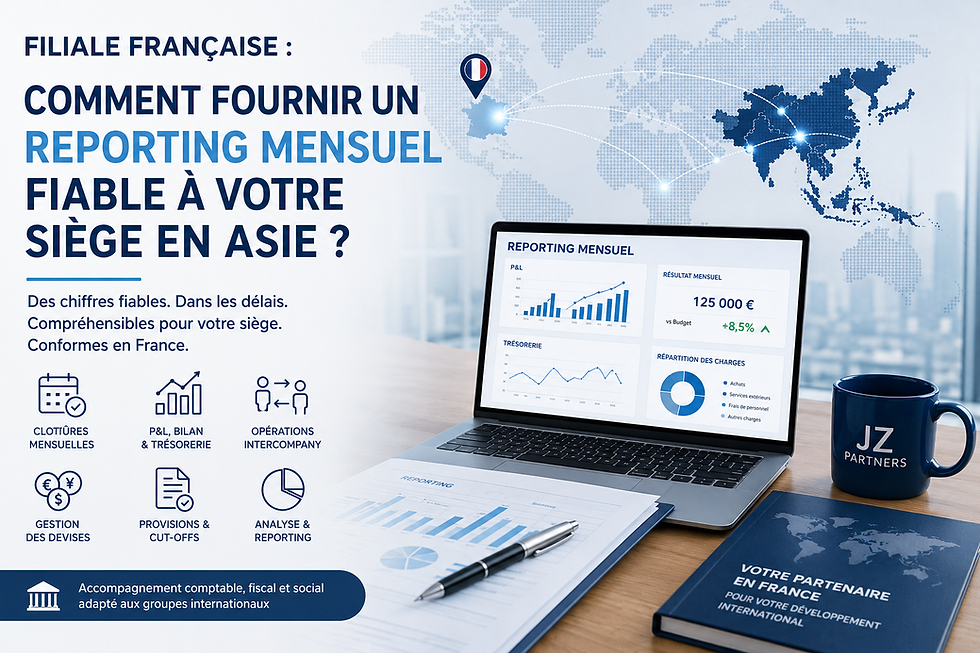
Financial reporting for international headquarters
Tax and financial advisory services
Whether you are launching a new business in France, expanding an existing company or managing a French subsidiary of an international group, appropriate accounting and tax management can help support compliant and sustainable business operations.
Planning to establish or expand your business in France?
Contact JZ PARTNERS to discuss your French accounting, tax compliance and financial reporting needs.
Frequently Asked Questions (FAQ)
What is the micro-enterprise turnover limit in France in 2027?
The general thresholds are €203,100 for qualifying sales activities and €83,600 for commercial services and BNC activities. Certain activities are subject to special rules.
Can a French SASU use the micro-enterprise tax regime?
No. A SASU is a company with a distinct legal structure and does not qualify for the micro-enterprise regime. It is generally subject to corporate income tax, with a temporary IR option
available under certain conditions.
Does a micro-enterprise have to charge VAT in France?
Not necessarily. VAT obligations depend on the separate VAT exemption thresholds, the nature of the transactions and other applicable conditions.
Is the simplified actual-profit tax regime abolished in 2027?
No. The simplified actual-profit regime for business income remains in place. The scheduled 2027 reform concerns the general simplified VAT reporting regime.
What is the French corporate income tax rate in 2027?
The standard rate is 25%. Eligible SMEs may benefit from a reduced 15% rate on the first €42,500 of taxable profits.
Should a French SCI choose IR or IS?
The decision depends on the property investment strategy, financing, rental activity, depreciation, holding period and potential disposal.
Does a foreign-owned company in France need an accountant?
French law does not generally require every business to appoint an external accountant. However, professional accounting support can help companies meet their statutory obligations and manage financial reporting effectively.
Disclaimer: This article is based on French tax rules and reforms announced or published as of November 2026. Certain provisions may change before or during 2027. The information is provided for general guidance only and does not constitute individual tax advice.
JZ PARTNERS — Accounting, Tax Compliance and Financial Reporting in France.
French business tax regimes 2027.
Comments